Metallized Kapton® Tape FAQ
FAQ: Understanding Metallized Kapton® Tape for Aerospace Applications
When it comes to surviving the harsh realities of space, standard materials simply won’t cut it. Spacecraft components are subjected to extreme temperature swings, intense radiation, and electrostatic build-up. To combat these challenges, aerospace engineers rely heavily on Metallized Kapton® Tape.
Below, we answer the most frequently asked questions about this high-performance material, its thermal management properties, and its critical role in Multi-Layer Insulation (MLI) systems.
Q: What is Metallized Kapton® tape, and why is it uniquely suited for aerospace applications?
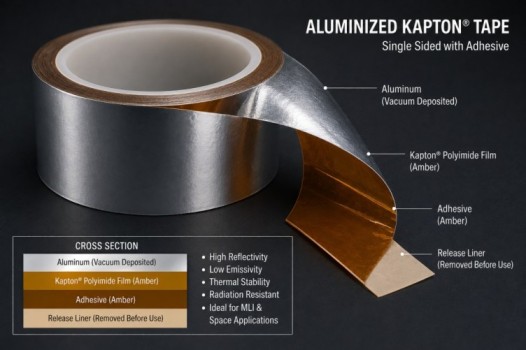
A: Metallized Kapton® tape is a high-performance aerospace tape combining a polyimide (Kapton) substrate with a thin, vacuum-deposited metal layer. It is the premier choice for sealing MLI blanket edges, assembling MLI blankets, and bonding thermal foils together or directly to a spacecraft’s structure.
Its unique suitability boils down to three core characteristics:
- Thermal Stability: Thanks to the rugged Kapton substrate, the tape maintains its structural integrity at extreme temperatures up to 290°C.
- Radiative Capacity: The Vacuum Deposited Aluminum (VDA) side boasts low emissivity, making it highly efficient at managing radiant heat.
- ESD Protection: The VDA side is electrically conductive, allowing engineers to ground the tape directly to the spacecraft structure, which safely bleeds off ElectroStatic Discharge (ESD).
Q: What metals are used in the metallization layer, and how does the choice affect cost and performance?
A: Historically, Gold metallization was the gold standard (literally) for MLI coatings due to its exceptionally low emissivity ($< 0.03$). However, due to the high cost of gold, the aerospace industry has largely transitioned to a much more cost-effective alternative: Aluminum.
By applying a Vacuum Deposited Aluminum (VDA) coating to a translucent Kapton HN substrate, you get a dual-sided color dynamic:
- The VDA side appears silver.
- The reverse side appears gold due to the natural yellowish hue of the underlying Kapton substrate.
While aluminum has a slightly higher emissivity than gold, it represents the ideal compromise between cost-efficiency and high-performance thermal management design. Note: Pure silver coatings are not typically used in these specific tape applications due to environmental degradation and performance constraints.
Q: What are the primary thermal management functions of Metallized Kapton® tape in space?
A: In the vacuum of space, heat is transferred entirely via radiation. Metallized Kapton® tape functions identically to a miniature MLI blanket to control this heat transfer.
It excels across temperature extremes ranging from -250°C to +290°C by balancing three key properties:
- High Heat Reflection: It bounces away intense solar radiation.
- Low Absorptance: It absorbs only a tiny percentage of solar heat.
- Low Emissivity: It features low Infra-Red (IR) emission, preventing internal heat from escaping or external heat from radiating inward.
Q: How does Metallized Kapton® tape perform under space radiation (UV, cosmic, and particle radiation)?
A: The Kapton polyimide substrate inherently offers excellent resistance to Ultraviolet (UV) radiation, ensuring it does not rapidly degrade or become brittle when exposed to unfiltered sunlight in space.
Technical Note: While Kapton is highly regarded for its robust resilience against UV radiation, specific endurance metrics regarding prolonged cosmic and particle radiation are continuously evaluated based on mission-specific orbits and shielding requirements.
Q: What adhesive systems are used on Dunmore’s Metallized Kapton® tapes, and how do they maintain bond integrity?
A: Dunmore utilizes advanced Pressure Sensitive Adhesives (PSA) engineered to survive the outgassing and temperature demands of space. We primarily offer two distinct adhesive systems depending on your electrical and structural needs:
| Adhesive Type | Bonding Strength | Electrical Conductivity | Primary Use Case |
| 966 PSA | High (>25 oz/in) | Non-Conductive | Maximum structural bonding and permanent foil/MLI assembly. |
| 9703 PSA | Medium ( >15 oz/in) | Conductive | Applications requiring an electrically conductive path through the adhesive. |
Our most widely specified flagship configuration is Dunmore DM100, which features a VDA layer, a 1 mil Kapton HN substrate, and the high-strength 966 PSA.
Want to learn more about Dunmore’s flight-proven material options or need a custom configuration for your next mission? Contact our aerospace engineering team today.