Metallized Polyester Film for Aerospace and Industrial Applications
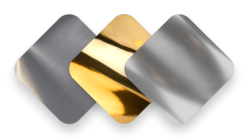
In spacecraft thermal control, metallized polyester is the core reflector layer inside multi-layer insulation (MLI) blankets. Dunmore converts aerospace-grade metallized PET alongside specialized conductive, barrier, and decorative films for a wide variety of high-performance applications.
Why Engineers Choose Dunmore Metallized PET
While metallized PET is a widespread commodity in flexible packaging, aerospace-grade film requires a completely different level of quality, consistency, and precision control. Dunmore converts both commodity and flight-ready materials, backed by rigorous ISO 9001:2015 certified quality systems and four decades of heritage supplying the global space industry.
- Proven Flight Heritage: Dunmore thermal control materials have supplied space missions since 1985 from our Bristol, Pennsylvania facility—including NASA’s historic Cassini mission (featured in NASA’s Spinoff 2016 report).
- Known Electrical Performance: Standard conductive constructions offer tightly controlled sheet resistance: 1.80 Ω/sq for aluminum-coated PET and 0.80 Ω/sq for copper-coated PET.
- Multi-Substrate Capability: Beyond PET, Dunmore applies vacuum metallization across a wide range of engineering polymers, including polyimide, fluoropolymers (Tedlar®, ETFE, ECTFE, FEP), PEEK, BOPP, and LDPE.
Technical Specifications at a Glance
| Property | Standard Value / Options |
| Base Substrates | Polyester (PET), Polyimide, Fluoropolymers (FEP, ETFE, ECTFE, Tedlar®), PEEK, BOPP, LDPE |
| Metal Deposit Layer | Aluminum (standard), Copper (available) |
| Sheet Resistance (Al / PET) | 1.80 Ω/sq |
| Sheet Resistance (Cu / PET) | 0.80 Ω/sq |
| Common Finishes | Bright chrome, gold, brushed stainless, pewter, matte aluminum |
Where Is Metallized Polyester Film Used?
- Spacecraft Thermal Protection: In MLI insulation blankets, aluminized PET forms the internal stacked reflector layers that block radiative heat transfer. It serves as a foundational component in Dunmore’s custom MLI films and ready-to-integrate Satkit MLI solutions.
- Reflective Building Insulation: Utilized as radiation barriers in commercial and residential construction.
- Flexible Packaging & Electronics: Serves as high-barrier layers against moisture and oxygen, as well as flexible conductive substrates in electronic assemblies.
- Specialty Surfacing: Applied as durable, decorative metal finishes for labels and architectural surfacing.
Frequently Asked Questions (FAQ)
What is the difference between metallized and aluminized film?
Aluminized film is simply a metallized film where the deposited metal layer is aluminum. “Metallized” is the broader umbrella term covering any film with a vacuum-deposited metal coating, including copper, gold, or silver. Most spacecraft MLI reflector layers utilize aluminized PET or aluminized polyimide.
Why is metallized PET used in MLI blankets?
The thin vacuum-deposited aluminum layer reflects radiant heat. By stacking multiple reflector layers separated by low-conductance spacer materials, radiative heat transfer is reduced to a fraction of a single layer. PET provides an exceptionally lightweight, strong, and dimensionally stable carrier film at a lower cost than polyimide for operating zones within its thermal limits.
What temperature can metallized polyester film handle?
PET has a narrower operating temperature range than polyimide (Kapton®). Because of this, MLI designs typically reserve polyimide-based films for the extreme outer/hot-side layers, while metallized PET handles the inner layers that stay within its thermal limits. Contact the Dunmore Aerospace team for grade-specific operating temperature thresholds.
Can Dunmore metallize films other than polyester?
Yes. Dunmore routinely applies aluminum or copper metallization to polyimide, Tedlar®, ETFE, ECTFE, FEP, PEEK, BOPP, and LDPE substrates.
What conductivity do Dunmore’s conductive films provide?
Standard aluminum-coated PET film measures 1.80 Ω/sq sheet resistance, while copper-coated PET delivers 0.80 Ω/sq.
Ready to Spec Your Thermal Material?
Whether you are designing smallsat constellations or deep-space probes, Dunmore provides precision thermal protection materials tailored to your exact mission parameters.